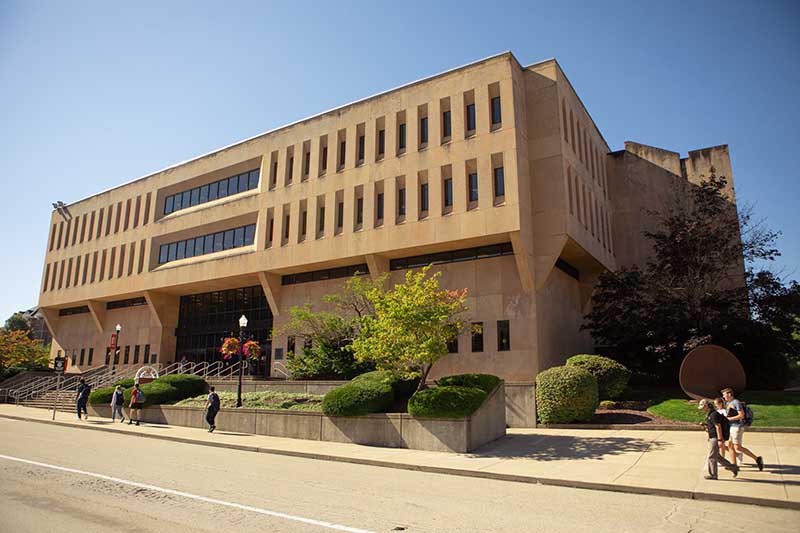
The Manderino Library is home to many of PennWest California’s more laid-back activities. On any of the four floors, students can be found studying, attending classes, walking through the art gallery, or even participating in quiet scavenger hunts with friends.
Keyword: quiet.
But on Thursdays at 5 p.m., the Manderino Library becomes a home to the medieval.
Past the reference desk and into the old printing center, a completely unsuspecting academic environment becomes a low-stakes battlefield.
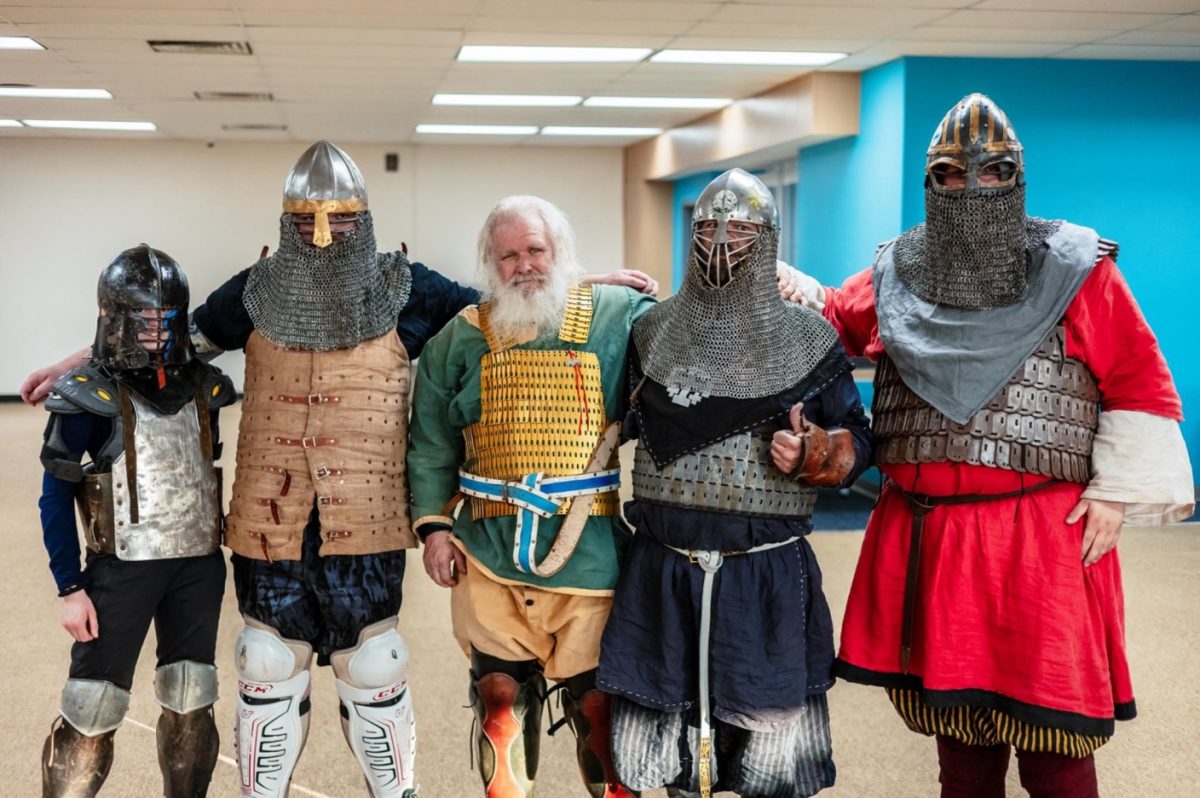
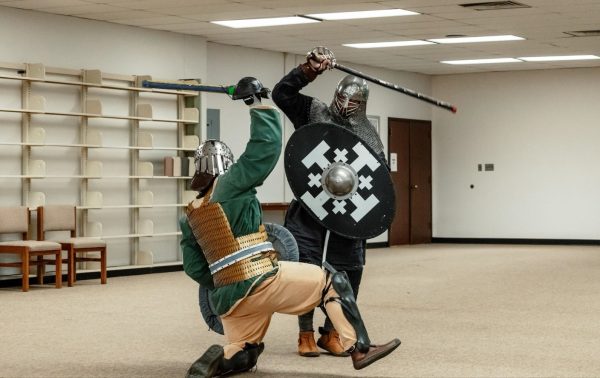
Backpacks are replaced with armor bags. Sweatshirts give way to chain mail. Heavy metal helmets supplant the unsuspecting bowl cut. Rattan swords are drawn, and shields are lifted.
You can hear the hollow thwack of wood colliding with wood, followed by someone yelling, “Good!” with the enthusiasm of a football coach who just saw the perfect kickoff.
A knight wearing chainmail is being helped off the ground by a Viking. Helmets are re-adjusted, stances are taken, and the fighting continues.
Once a week, the Medieval Fighting Club and the Fencing Club meet to take the library back in time by a few hundred years.
The Society for Creative Anachronism
The Medieval Fighting Club is part of a much larger organization known as the Society for Creative Anachronism (SCA), where members call themselves SCAdians. This global organization is dedicated to recreating life in the pre-1600s.
Locally, that makes PennWest’s group part of the Kingdom of Æthelmearc. The Æthelmearc Kingdom reaches across all of Pennsylvania, West Virginia, and some of New York.
The club was formally established in 2008 by Cindy Speer, an administrative assistant, though its beginnings can be traced back to 2007. After seeing an on-campus event that involved Michigan sword fighters and Friesian horses, Speer experienced what can only be described as immediate enthusiasm.
Her GA asked if she would be interested in starting a club, and she instantly said “yes.”
Many recruitments happen in similar ways to Speer. They see something they like, which in this case is fully- armored fighters swinging rattan swords at each other. What begins as curiosity turns into participation, and the well-seasoned fighters of the Medieval Fight Club are happy to welcome newcomers.
“If you’re new, we’re happy to show you the ropes,” Layla Koon (Toroll Swordbreaker), a senior Chemistry major said. “It’s for everyone, but you should at least be okay with loud noises.”
When weapons clash with metal armor, and armor clashes with wooden or metal shields, the practice room can get loud fast.
The Weighted Vest: Medieval Edition
Fighters wear between 30 and 50 lbs of armor made of steel and leather, with just the helmets weighing between 8 and 12 lbs. Rows of narrow steel plates are laced together to form a cuirass that drapes over torsos. Leather straps crisscross to buckle gauntlets and chest plates in place. Chain mail hangs off helmets, which are scuffed from hours on the battlefield.
Movement in full kit is immediately redefined by Koon as “unexpected cardio.”
“You’re louder and slower,” senior English major Jacob Karfonta (Willhelm) added. “You know, people think athletes are only, like, football, baseball, or soccer. You see them maybe moving more and faster than we are. If someone doesn’t want to call us athletes. I’ll just say this: we put in the sweat.”
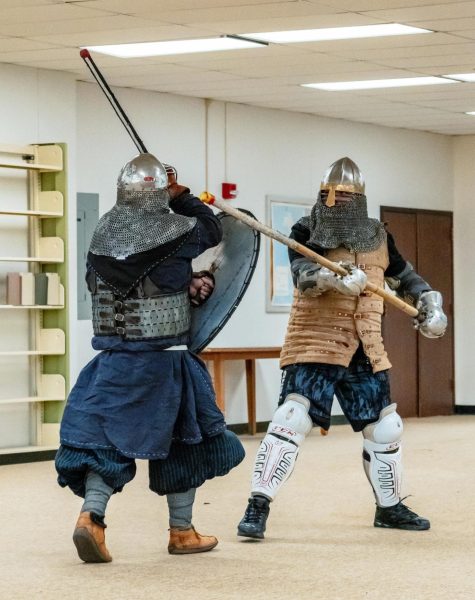
Willhelm lifts his shield a second too late and Bjorn brings his sword down onto the metal. It forces Willhelm back astep, and Bjorn hews his weapon into Willhelm’s helmet. The sound is dull, but within the helmet, the impact is much louder.
“The helmets are pretty much concussion-proof,” George Cole-Hough (Bjorn Ericksson Undan Fjalli) said, knocking his helmet with his shield to prove his point. “But once you hit someone on their head, that means you killed them.”
“Obviously not literally,” Karfonta added, still very much alive.
As they reposition themselves, “Hold!” is yelled from several club members, and the two fighters immediately pause.
Closed helmets can significantly impact peripheral and downward vision. Because of that, the fighters have strict safety guidelines in place to protect themselves and unsuspecting student reporters who might walk in mid-practice.
That means once “Hold!” is yelled, all participants stop mid-swing, thrust, and jab, until the area is clear again.
Despite how intimidating it might look, fighters train in technique and regularly pause to give each other feedback on form and timing. A typical exchange can include a solid hit, a step back, and a calm discussion about whether that hit would have landed as powerfully under slightly different conditions.
Outsiders might see their practices as a hobby, but for the fighters, they’re training for war. And in war, you have to make sure you can hack, slash, and block while running full-speed in 50 lbs armor.
Luckily, injury rates remain relatively low. One long-time participant reported only having one major injury, a torn ACL, over more than two decades of fighting.
Karfonta says, “It’s just bruises and scratches mostly. Those come with any contact sport.”
Steer says that one of the biggest misconceptions about the Medieval Fighting Club is that joining is expensive. While full armor sets can be, with just the helmet costing anywhere from $200-500, the SCAdians make it a point of lowering that barrier so newcomers can enter without worrying about the cost.
Having equipment is not a prerequisite for joining. The community operates on a more flexible system built around sharing, lending, and gifting to nobles new to the scene.
As Koon explained, the club is intentionally accessible: “If you want to do any kind of fighting here, we have all of the armor available. If you want to just see what it feels like to swing a sword, we have the stuff to just let you try. We’ll introduce you to all of the important stuff.”
As members become integrated into the group, equipment tends to accumulate through community generosity. “The armor I’m wearing was almost completely gifted to me. Bjorn’s helmet was given to him, and his garb was handmade and given to him,” Koon said.
“I’m getting a new helmet soon,” Bjorn added. “Can’t wait.”
Combat, Crafts, and Historically Accurate Snacks
Members are quick to explain that the SCA is not just about combat. This clarification is usually delivered between the clashing of shields and a 7 ft. halberd.
On the outskirts of the fighting, you can expect to see a number of club members working on various creative endeavors, from painting to knitting.
“There’s something here for everyone,” Koon says. “It’s like showing up to a Ren Fair, but we also do way more.”
The “way more” includes a number of activities, like making garb, blacksmithing, bardic performance, art, and cooking from medieval manuscripts. That’s just to name a few. Essentially, if it existed before 1600, there’s a SCAdian somewhere in the world mastering it.
“It’s all-encompassing. Anything from modern times, you can somehow incorporate into the medieval time period,” says Koon. “This isn’t just a fight club. Anyone can join and find their place in the community.”
So while some members are perfecting sword technique, others are perfecting recipes, songs, and other projects to add to the immersion. Each pursuit is treated with the same level of dedication and respect from the community.
Cole-Hough’s garb, notably, was made by a princess. Yes, the SCA has royalty!
Crown Tournaments are held twice a year. Hundreds of men and women flood a battle ground, and the couple who wins is crowned Prince and Princess of the kingdom for three months until their coronation as King and Queen. The King and Queen reign over their kingdom for six months until the next Prince and Princess step up.
A Way of Life
For many SCAdians, the organization becomes more than a hobby. Several members that practice in the Manderino library have been fighting for the majority of their lives, building friendships (and occasionally families), and have integrated medieval history into their everyday lives.
Alumna Amanda Coldren, known as Nea Kimball in the club, is originally from Toledo, Ohio. She enrolled at Cal U in 2021 because there was an archeology program and an SCA group.
It was the best of both worlds. In practice, it meant that she could study the past during class and then hit people with swords in the present.
“I left Ohio for Pennsylvania because of this club,” Coldren says. “No college really has this. When I was told that the archeology program was being cut in my freshman year, I had to make a decision. I could transfer to, you know, a different college with the program, or I could change my major and stay. And I did. I stayed for the club.”
Because she stayed, she met her husband, Derek Coldren, a 2019 Cal U graduate. When she graduated, her cap had two student IDs on it: one from Cal U and one from PennWest. And with them was her medieval heraldry.
Coldren hopes that, in the future, she’ll be Queen of Æthelmearc. For now, she’s an artist for the Kingdom. Most recently, she worked on hand-painting over 400 tokens to give to other members at a coronation ceremony for this term’s Æthelmearc King and Queen, where her art will be presented to the royalty.
From the Library to the Battlefield
This chapter of SCA connects to larger events, including the Pennsic War, the largest medieval re-enactment in the world, where 10,000 SCAdians gather in Slippery Rock. This year, knights, vikings, and everything in between will gather on a battlefield to celebrate the 53rd Pennsic War.
“It’s fun, especially, you know, the big fights. Because when you have hundreds of people on every side of you, it feels like you’re actually marching into battle against other foes,” Karfonta says.
That is why their weekly fighting practice is so important. While fighters clash and die honorable deaths on the library floor, other members laugh, talk, adjust armor, and cheer each other on. It’s a group project people actually want to be a part of.
Gatherings like this are hosted almost every day all across the Kingdom. At some of them, you might even get to meet the King and Queen of Æthelmearc.
“I personally know the prince,” Cole-Hough says. “You know. No big deal.”