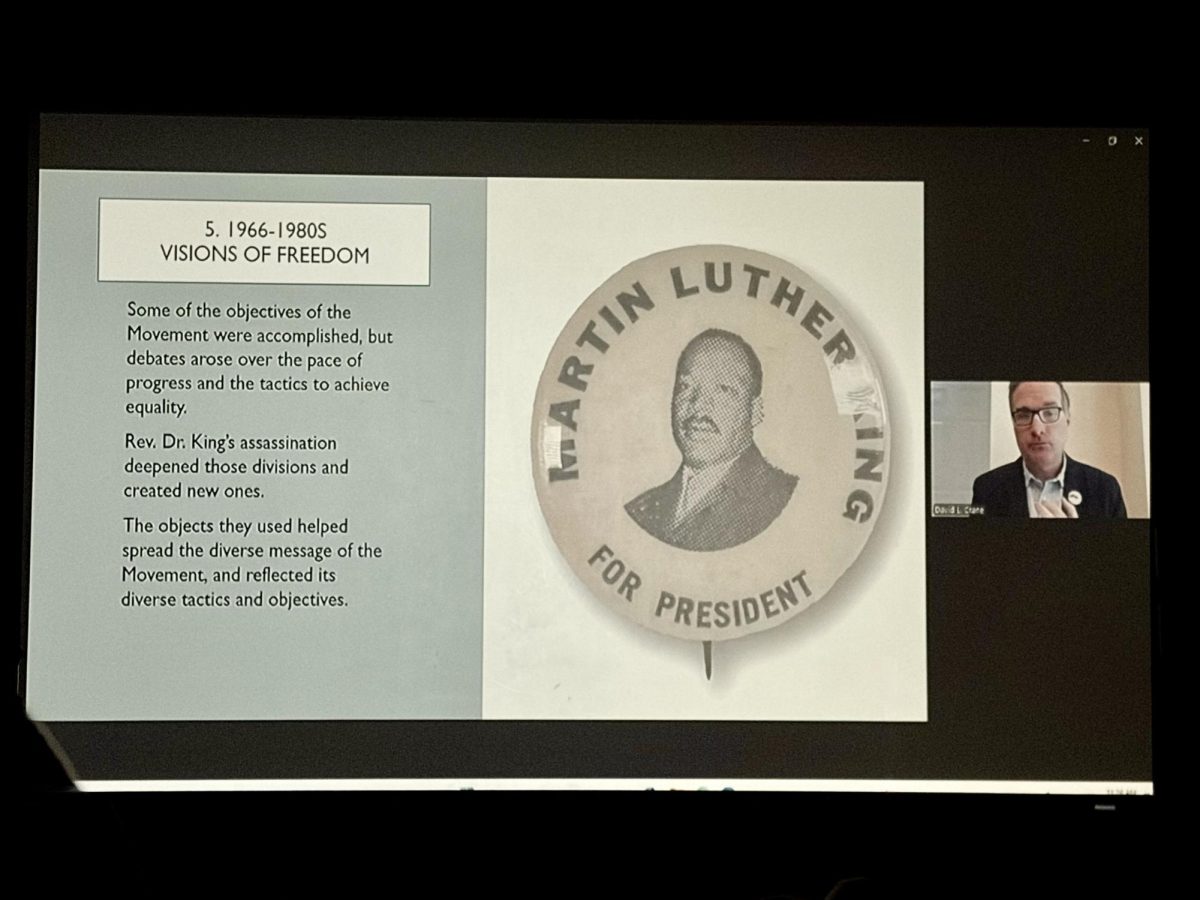
PennWest hosted a virtual program highlighting author, historian, and activist David L. Crane’s work with the material culture of the Civil Rights Movement.
Crane is the founder of the Making the Movement Civil Rights Museum, a traveling exhibition featuring authentic materials worn by protesters and activists, and the author of “Making the Movement: How Activists Fought for Civil Rights with Buttons, Flyers, Pins and Posters,” a book explaining the significance of these items.
The National Day of Racial Healing program was open to PennWest students, faculty and staff, as well as members of the public. The program took place on Monday, Feb. 2nd.
After an introduction by Dr. Sheleta Camarda-Webb on behalf of the PennWest Office of Community, Opportunity, Responsibility and Engagement (CORE), Crane began walking listeners through the different eras of the Civil Rights Movement, showing pictures of material culture from each:
“These objects were not souvenirs…they were nonviolent weapons that fought Jim Crow,” Crane said of each piece in his collection.
These small pieces of history helped activists spread the word, recruit new members, raise money, influence legislation, organize marches and protests, and ultimately change minds.
The first artifact Crane bought for his collection was a National Association for the Advancement of Colored People (NAACP) member pin from 1954. He bought it on EBay, and it was less than twenty dollars.
“It was in the same category as lunchboxes and bobbleheads,” Crane said, noting the lack of advocacy and preserved history from the movement at that time.
He also explained several of the myths behind famous activists, including Rosa Parks:
“It depicts her as kind of a meek bystander, caught up in events beyond her control. The reality is the complete opposite: she was a secretary for NAACP by this point. She was a longtime activist by the time the Montgomery bus boycotts happened,” Crane said.
He talked about the planning and preparation that went into each act of protest during the movement, especially in the 1960s.
“They don’t make (the buttons and materials) on the day of, this is months and months of preparation,” Crane said.
He then showed several pictures of notable marches and had viewers consider the images without their material culture.
“Take away all of those buttons. Think about the impact that these objects have. They help spread the word. These are just people standing in the streets, without the material culture,” Crane said. “It lets people know what the objectives and the strategies of the movement are.”
Crane had the opportunity to meet and work with several notable Civil Rights Movement leaders and advocates throughout his time gathering the collection, including Julian Bond, John Lewis, C.T. Vivian, and Ambassador Andrew Young. The men convinced Crane to write his book.
“(Julian Bond) pulled me aside later pretty sternly…he said, if you don’t write this book, it’s never going to be written. And this story is not going to be told,” Crane said. “It really lit a fire and made me understand that this was significant.”
Crane has seen firsthand the racial prejudice still prevalent in the world today. On a trip through the south with Professor Bond, the notable Georgia politician, activist, and former NAACP Chairman, he recalls stopping for lunch.
“We went to a little restaurant in Selma…They were not happy to see Julian Bond and me walk in with this (equality) button, I’ll tell you that right now,” he said. “They dropped our silverware. I didn’t eat that sandwich, let’s put it that way.”
He then noticed a troubling artifact from the Bloody Sunday (Mar. 7, 1965) attacks on Civil Rights marchers.
“Behind the bar was a helmet from one of the state troopers that beat John Lewis on the bridge within sight of the restaurant. They had it nailed to the back of the bar,” Crane said. It put the significance of the small buttons and pins in perspective for him.
“(Most people are) learning about the movement as a result of seeing it now. This was a tool and a weapon, but it could also have been a bullseye for someone wearing it,” he said solemnly.
Although the experience was troubling, Crane said there is a necessity for material culture in regard to the movement:
“It is not artwork to be hung on a wall, it has to be worn or held in public for it to have significance.”
One of Dr. Camarda-Webb’s questions to Crane at the end of the seminar was about the parallels between past tools and today’s digital resources and organizing, and both agreed that the digital age could be used to protestor’s advantages.
“It has to be a part of a concerted strategy. That’s one tool in your toolbox, along with meetings and organizations and marches, is posting on social media and talking about how you feel,” Crane said.
Dr. Michelle Torregano, an Education professor and PennWest’s director of the Frederick Douglass Institute Collaborative, made an important statement about social justice advocacy:
“I am an unapologetic advocate for social justice,” Torregano said. “You don’t have to be a black person for it to have an effect on you. I’m asking you to open up your eyes and see what’s going on.”
Torregano said she has a vision for her current and future students.
“My wish for you is to live in a society where there is peace and harmony,” Torregano said. “You matter to me, and your lives matter to me.”
Crane encouraged listeners to educate themselves, join the fight for what they believe in, and embrace the material culture that helps achieve these goals.
“This is a fight, this is a struggle, but we have weapons. It’s not violence, violence categorically is not the answer. It does not work,” he explained. “Strategy works. Material culture works. Organizing works. Changing minds works…We’re gonna have to fight the war. We’re gonna have to get some wounds. We have to develop some scars. Then we heal when there’s a reason to do so.”
David L. Crane is accessible through his website, makingthemovement.com, as well as on social media @mtm_museum.